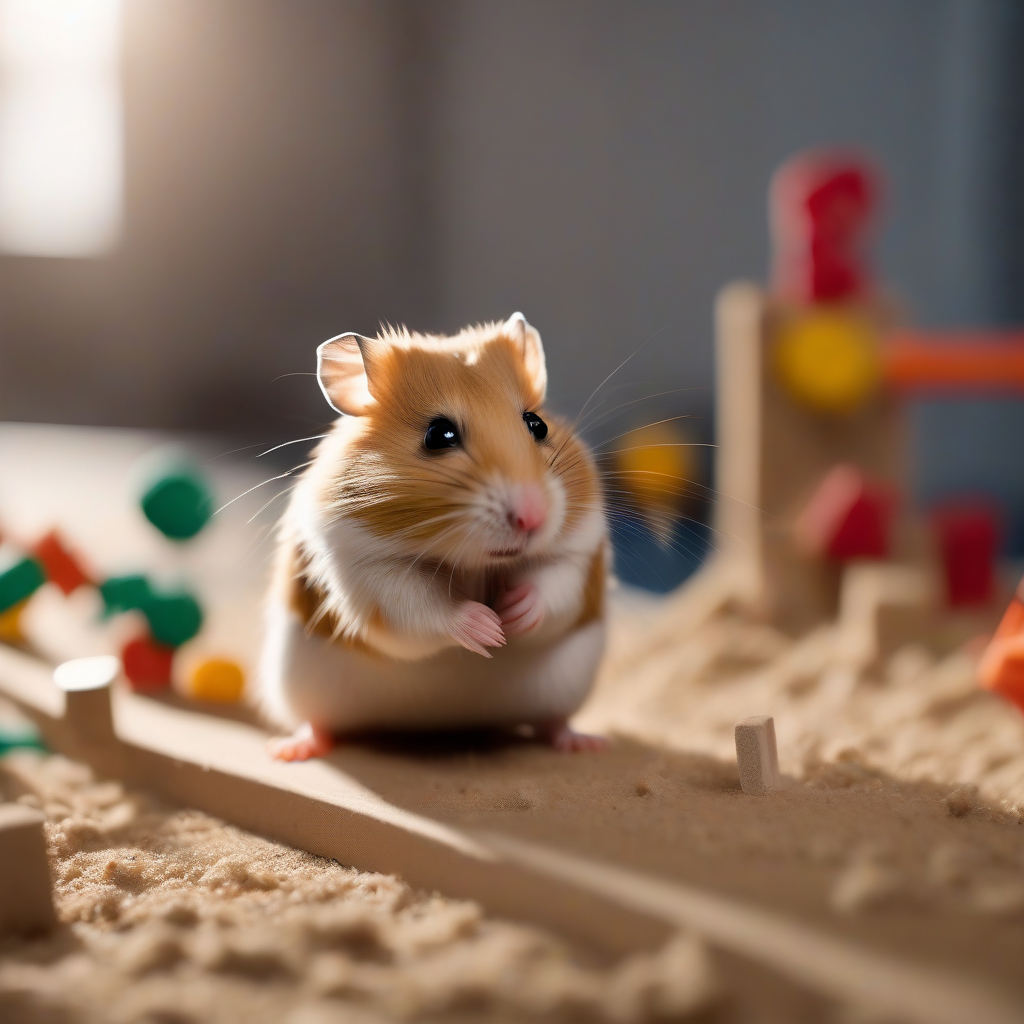
In this article, you will discover the neurocognitive secrets behind how your hamster can learn complex task chains step-by-step, along with advanced training tactics. We delve into maximizing your tiny friend's mental potential beyond simple commands from a scientific perspective.

In this article, you will find comprehensive information about the insidious neurobiological effects of artificial colorings, preservatives, and flavors found in commercial bird feeds on your bird's brain health and mental vitality. We explore scientific nutritional secrets to combat these hidden dangers, shedding light on a wide spectrum of effects from behavioral changes to cognitive decline.

In this article, you can discover the scientific secrets to understanding your cat's undesirable habits, deciphering the neurocognitive mechanisms in their brain, and establishing lasting new routines.

Discover the types of burns your dog can suffer, the 5 insidious neurophysiological effects these burns create in the brain and body, and lifesaving emergency intervention strategies in this comprehensive guide. We shed light on the dangers behind forgotten household accidents from a scientific perspective.
Despite their tiny size, hamsters are creatures with surprising intelligence and learning capacity. While often seen merely as animals running on a wheel or stuffing their cheek pouches, with the right approach, they can learn complex task chains, develop problem-solving skills, and even perform small tricks. However, teaching them more than simple commands requires understanding how your hamster's brain works. In this article, we will delve into the 5 neurocognitive secrets behind your hamster's 'step-by-step genius' in learning complex task chains and explore advanced training tactics.
All animals, including hamsters, learn complex tasks by breaking them down into smaller, manageable sub-steps. This process is governed by brain regions such as the prefrontal cortex and basal ganglia. The prefrontal cortex is responsible for planning and decision-making, while the basal ganglia play a critical role in habit formation and sequence learning mechanisms. When teaching a hamster to overcome an obstacle, pass through a tunnel, and then trigger a reward mechanism, we are essentially enabling its brain to encode each action as a separate 'chunk' of information. This neurobiological segmentation allows the brain to process each step as an independent unit, which are then integrated into a coherent sequence. In the initial stage of training, reinforcing each sub-step individually is key to forming strong synaptic connections in your hamster's brain. This ensures that these steps can later be smoothly put together. This process in your hamster's brain forms the basis of its problem-solving ability, as discussed in the article Your Hamster's 'Secret Mind Maze': 5 Neurocognitive Secrets to Boosting Problem-Solving Skills and Scientific Training Tactics!.
There are two primary methods for teaching complex behavior chains: backward chaining and forward chaining. Both have distinct neurocognitive benefits:
Reinforcement schedules play a pivotal role in a hamster's learning of a complex task. The brain's reward centers (particularly the ventral tegmental area and nucleus accumbens) reinforce learning and motivation through dopamine release. In the initial stages, immediate reward for every correct step (continuous reinforcement) accelerates learning and promotes synaptic strengthening. However, as the behavior becomes established, switching to intermittent reinforcement schedules (e.g., rewarding after every 2 or 3 correct steps) makes the behavior more durable and increases its resistance to extinction. Unexpected rewards can deepen learning by increasing the brain's attention and motivation. This is a fundamental principle that also influences the hamster's ability to learn commands, as discussed in articles like Your Hamster's 'Secret Semantic Map': 5 Neurocognitive Secrets to Responding to Specific Verbal Cues and Scientific Training Tactics!.
The training environment itself has a significant impact on your hamster's learning ability. An overly stimulating or too simplistic environment can hinder learning. When teaching a new task, it's important to minimize distractions initially. This allows the hamster's brain to process new information more effectively and reduces cognitive load. As the hamster masters the task, you can gradually increase the complexity of the environment (e.g., in different locations or with slight distractions) to develop its generalization skills. This is directly related to environmental enrichment, highlighted in the article Your Hamster's 'Cognitive Labyrinth' Need: 5 Insidious Neurobiological Effects of Insufficient Environmental Complexity on the Brain and Secrets to Mental Enrichment!. Proper management of cognitive load keeps stress levels low and ensures the brain remains in an optimal learning state.
In every training process, there may be moments when your hamster reaches a 'learning plateau'; that is, progress stops or slows down. This could mean the brain needs a break to integrate new information or that the current method is no longer effective enough. Neurocognitively, this indicates that the brain needs to strengthen existing synaptic connections or seek new strategies. Patience and flexibility are critical during these moments. Shortening training sessions, trying different rewards, breaking the task down into even smaller steps, or temporarily working on a different skill can increase your hamster's mental flexibility. Sometimes, a short break allows the brain to process information subconsciously and return with a fresh perspective. Keeping your hamster's motivation and exploration drive alive is essential to overcome these plateaus.
Working on complex task chains with your hamster not only teaches it new skills but also stimulates it mentally, strengthens the bond between you, and improves its quality of life. Every hamster's learning pace and style are different; therefore, patience, consistency, and positive reinforcement are key. With these scientific approaches, you can unleash your tiny friend's 'step-by-step genius' and enrich the time you spend together.
