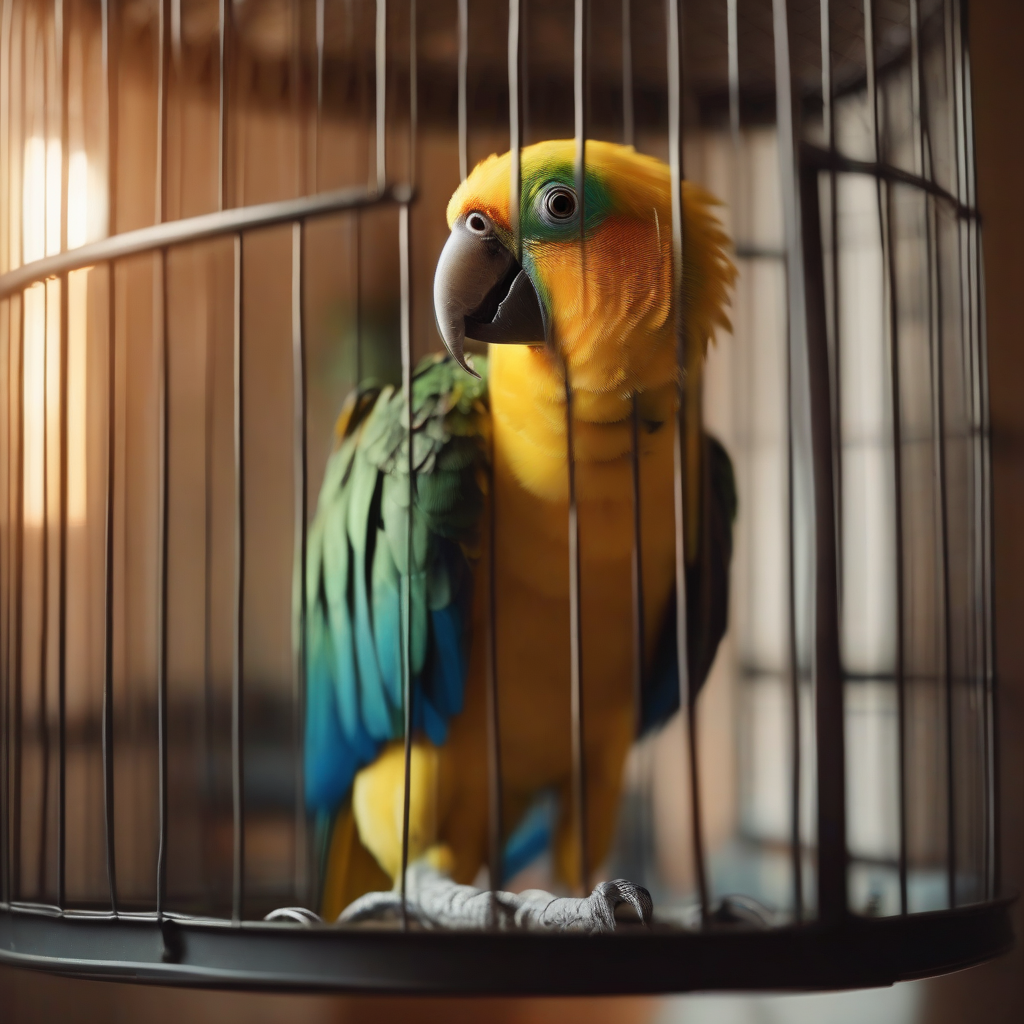
Adapting to a new home is fraught with complex neurocognitive obstacles for birds. In this article, you will discover 5 hidden neurocognitive barriers that cause your bird to 'misperceive' its new environment and learn scientific strategies to overcome them.

While cats possess a surprising ability to adapt to high-rise fall traumas, the insidious neurophysiological effects on their brain carry vital risks. In this article, we reveal 5 critical neurobiological effects your cat may experience after a fall and the lifesaving emergency intervention codes with scientific secrets.
In this article, you will discover how your rabbit copes with unexpected situations and its neurocognitive responses to non-routine events. Learn scientific secrets to enhance mental flexibility and manage stress.
In this article, you will find comprehensive information on the insidious neurophysiological effects of seizures in cats' brains and lifesaving emergency intervention codes during a seizure.
Adopting a new bird is an exciting new beginning for both you and your tiny companion. However, your bird's adaptation to its new home doesn't always go smoothly. Often, beyond visible external factors, 'silent perception errors' occurring in your bird's brain disrupt this process. Birds, with their prey animal instincts and cognitive structures shaped by their natural habitats, can react differently to many stimuli in a home environment. In this article, we will delve into 5 hidden neurocognitive obstacles that cause your bird to 'misperceive' its new environment and explore scientific solution strategies you can implement to overcome these barriers.
Birds interpret their environment with extraordinary sensitivity for survival. Every new sound, every movement, and every scent is rapidly processed as a potential threat or opportunity. A new home can overwhelm this delicate perceptual system. Away from everything familiar, their predator instincts are triggered, encountering signals they struggle to comprehend in a human-made environment. This negatively impacts their natural behaviors and learning capacity, prolonging or completely hindering the adaptation process.
For a bird naturally programmed to fly freely across thousands of square kilometers, even the largest cage is perceived as a restriction. This is not merely a physical barrier but a significant neurocognitive conflict. As the bird's brain anticipates flight, constantly encountering boundaries triggers stress responses. Stress-related brain regions like the amygdala and HPA axis become overactive, while dopaminergic activity, linked to exploration and reward, decreases, suppressing these behaviors.
Solution Strategies: Encourage supervised flights in safe, bird-proofed rooms outside the cage. Provide vertical enrichment within the cage with perches of varying heights and textures (Your Bird's 'Secret Balance Algorithm': 5 Neurocognitive Secrets of Perch Selection and Scientific Comfort Zone for Zero Stress!). Use mental stimulation such as foraging toys or puzzle feeders. This helps meet the brain's need for exploration and problem-solving, even in a confined space.
Household sounds like TV, vacuum cleaners, phone rings, or other pets, while part of daily life for humans, can be unpredictable and potentially threatening signals for a bird. Birds rely heavily on their auditory senses for predator protection and social communication. These unexpected and loud noises overstimulate auditory processing centers in the midbrain, leading to exaggerated startle responses and chronic cortisol release. As detailed in The 'Secret Soundscape' in Your Bird's Mind: 5 Neurobiological Effects of the Home's Micro-Acoustic Environment and Secrets to a Peaceful Life, this increases your bird's stress.
Solution Strategies: Gradually acclimate your bird to household sounds. Start in a quiet room, then slowly expose it to normal home noises. White noise machines or calming music can mask sudden sound changes and help create a peaceful 'sound bubble'.
Birds are inherently highly social creatures and live in flocks. In a new home, even when surrounded by humans, perceiving the absence of a 'flock' of their own kind can lead to a profound sense of social isolation. This situation can lead to a decrease in bonding hormones like oxytocin and vasopressin, an increase in stress hormones, and negative impacts on social learning circuits. This can create effects similar to Your Bird's Hidden 'Abandonment Syndrome': Neurobiological Effects of Loneliness and Scientific Secrets to Bonding!.
Solution Strategies: Establish consistent and gentle interactions with your bird. Talk to it, sing, and play games. Mirrors, when used judiciously and supervised, can temporarily satisfy your bird's social needs. If appropriate and after careful research, consider acquiring a second bird. You can also help your bird understand you better with Your Bird's 'Emotional Radar': 5 Neurocognitive Secrets of Reading Owner's Micro-Expressions and Scientific Ways to Build Deep Bonds!.
A newly adopted bird, especially one with a history of trauma, may struggle to form trust with new humans. Every new hand, every sudden movement, excessively stimulates the brain's threat detection systems (amygdala), interpreting interactions as potential danger rather than positive stimuli. This reduces oxytocin release and hinders the formation of positive bonds. The sensitivity of this process is thoroughly explained in Your Bird's 'Trust Reflections': 5 Neurocognitive Secrets of First Contact After Adoption and Scientific Strategies for Lasting Bonding!.
Solution Strategies: Adopt a slow and patient approach. Respect your bird's personal space and allow it to approach you. Use positive reinforcement (praise, favorite treats) to associate human interactions with positive experiences. A consistent routine provides predictability and accelerates the trust-building process.
Birds thrive on daily routine and a predictable environment. A new environment is inherently full of uncertainties. Sudden changes in cage location, new furniture, guests, or even feeding times can create a huge stress burden on a bird's brain. This uncertainty activates chronic stress responses, lowering serotonin and dopamine levels, negatively impacting mood and motivation. Environmental factors like those discussed in Is Your Bird's 'Secret Stress Filter' Crashing? 5 Unknown Neurobiological Effects of Cage Environment and Scientific Design Secrets to Zero Stress! can also trigger these crises.
Solution Strategies: Establish a consistent daily routine for your bird: feeding, play, rest, and sleep times should be as regular as possible. Minimize environmental changes, and if a change must be made, gradually acclimate your bird to it. For example, introduce a new toy by placing it outside the cage first. Routine and predictability reduce your bird's perception of uncertainty, lowering stress levels, and preventing issues like Your Bird's Invisible 'Boredom Labyrinth': Neurobiological Origins of Repetitive Behaviors and Scientific Enrichment Strategies!.
Understanding your bird's 'silent perception errors' in a new environment is key to successful adaptation and building a strong human-bird bond. By recognizing these neurocognitive obstacles and applying science-based solution strategies, you can reduce your tiny companion's stress and offer it a safe and peaceful living space. Remember, patience, observation, and compassion will enable your bird to truly adopt its new home as 'home'.
