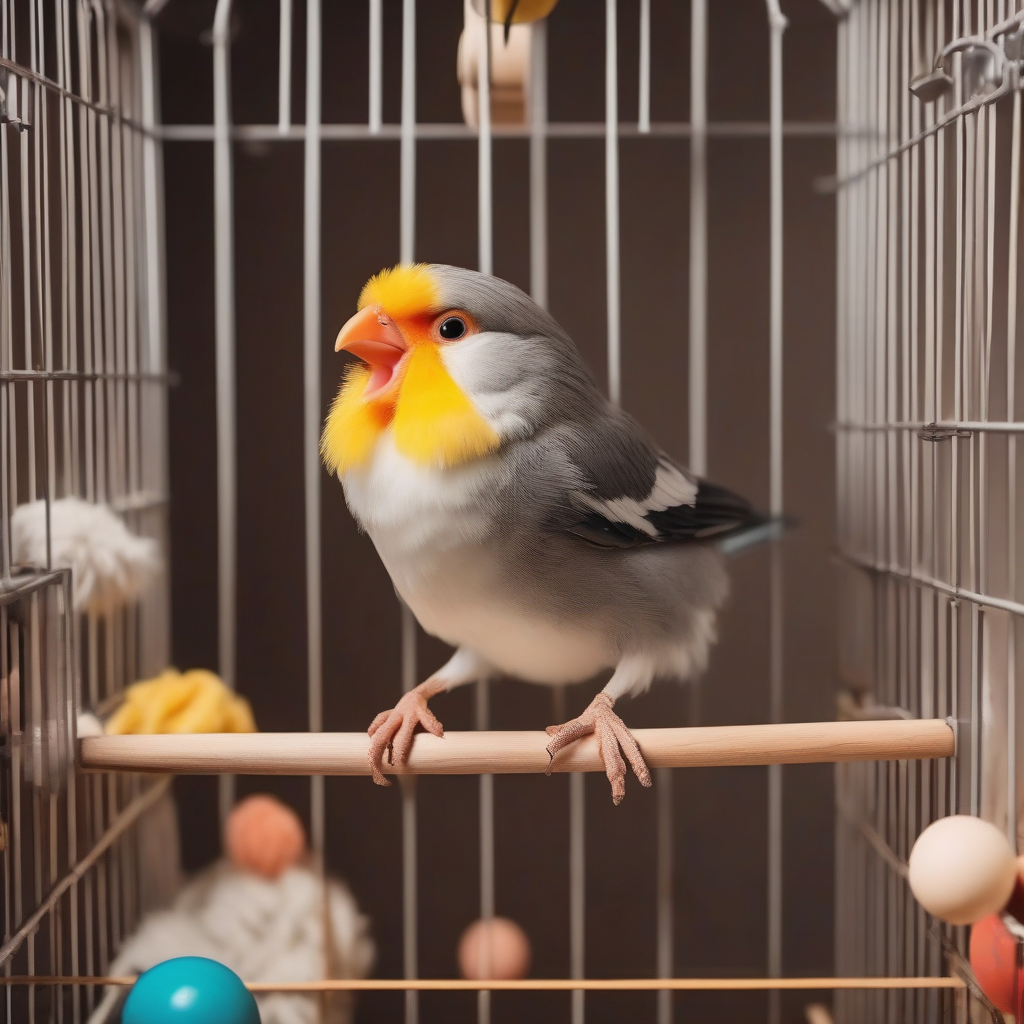
In this article, you will discover the profound neurocognitive effects of cage shape and volume, often overlooked in bird cage selection, on your bird's brain health. Learn scientific secrets to enhance your bird's mental well-being through optimal habitat design.

In this article, you will discover the profound neurocognitive effects of cage shape and volume, often overlooked in bird cage selection, on your bird's brain health. Learn scientific secrets to enhance your bird's mental well-being through optimal habitat design.
In this article, you will discover how your fish perceive visual cues and daily routines in the aquarium, the role of memory mechanisms in this process, and scientific training secrets you can apply to enhance their mental vitality.

In this article, you will discover the profound neurosensory effects of aquarium substrate on fish brain health and behavior, and scientific secrets for an optimal habitat.
The quality of life for our pet birds isn't just limited to the food and water we provide. In fact, the cage, where they spend most of their days, has profound neurocognitive effects on their mental and physical health. While cage size is often discussed, its shape and how its internal volume is utilized can radically alter how your bird's brain perceives the world, moves, and even socializes. An incorrectly designed cage can become a 'hidden geometric prison,' restricting your bird's cognitive abilities and leading to chronic stress. In this article, we will explore 5 insidious neurocognitive effects of cage shape and volume on your bird's brain and the scientific secrets to offering them mental freedom.
Birds live in vast natural environments and possess complex spatial perception abilities to navigate a three-dimensional world. Cage shape directly affects this natural ability. Round or very narrow, tall cages, in particular, can disrupt a bird's spatial memory and orientation. Their brains are programmed to create a 'map' using fixed visual cues and corners. The lack of such clear reference points in round cages can make the bird feel constantly 'lost.' Studies have shown that birds living in irregularly shaped or inadequately sized cages exhibit higher cortisol levels and display anxiety-related behaviors. This negatively affects brain regions responsible for spatial learning, such as the hippocampus, making it difficult for your bird to understand its environment and move safely.
The volume and shape of the cage directly impact your bird's natural movements – flying, climbing, flapping wings, and stretching. A cage that is too small or disproportionately shaped can prevent your bird from using its full wingspan or may not offer sufficient flying distance. These motor restrictions not only lead to physical health problems (muscle atrophy, obesity) but also negatively affect brain development. The bird's brain develops through the active use of regions involved in the complex coordination of motor skills. Restricted movement can decrease motor cortex activity, reducing learning ability and overall mental vitality. When insufficient space for movement is provided within the cage, birds can develop stereotypical behaviors due to frustration and stress. For example, pacing back and forth or feather plucking can be a neurobiological response to a confined environment.
The correct cage shape and volume are key to optimizing your bird's environmental enrichment. Square or rectangular cages allow for the strategic placement of different types of perches, toys, and foraging materials. An inadequate or oddly shaped cage restricts the possibilities for safe and stimulating placement of these items. This results in the bird's brain being unable to satisfy its need for new experiences, problem-solving, and exploration. Chronic boredom and a lack of cognitive stimulation can affect the brain's reward centers and lead to depression-like symptoms. Environments with insufficient enrichment can cause birds to lose their mental vitality and become passive.
Cage shape and size also influence a bird's social interactions and its need for privacy. This is critically important, especially for cages housing multiple birds or for birds that interact intensely with humans. Sufficiently large and correctly shaped cages offer areas where birds can 'escape' from each other or humans, or seek privacy. This feeling of a 'safe haven' is vital for reducing stress levels. Narrow or cornerless cages can restrict a bird's ability to distance itself from others or hide from perceived threats, leading to chronic stress. Birds sometimes also require space when integrating a new friend into an existing flock, highlighting the importance of cage size.
All the factors mentioned above – spatial confusion, movement restrictions, cognitive deprivation, and social stress – combine to trigger a continuous stress response in the bird's brain. Chronic stress causes stress hormones like cortisol to remain at consistently high levels. Prolonged high cortisol can damage neurons in the brain, affect memory and learning processes, and weaken the immune system. This severely threatens your bird's overall well-being and lifespan. Choosing the correct cage is key to preventing this 'chemical storm' in your bird's brain and ensuring they lead a more peaceful, healthy life. Elements like cage bars also affect a bird's mental health; for detailed information, please read our article on The Effect of Cage Bars on Brain Health.
Your bird's cage is not just a shelter; it is its world. The correct cage shape and volume are vital for your bird's brain to stay healthy, its cognitive abilities to develop, and for it to lead a generally happy life. By applying these scientific secrets, you can offer your beloved companions a habitat full of mental freedom and well-being.
